Table of Contents
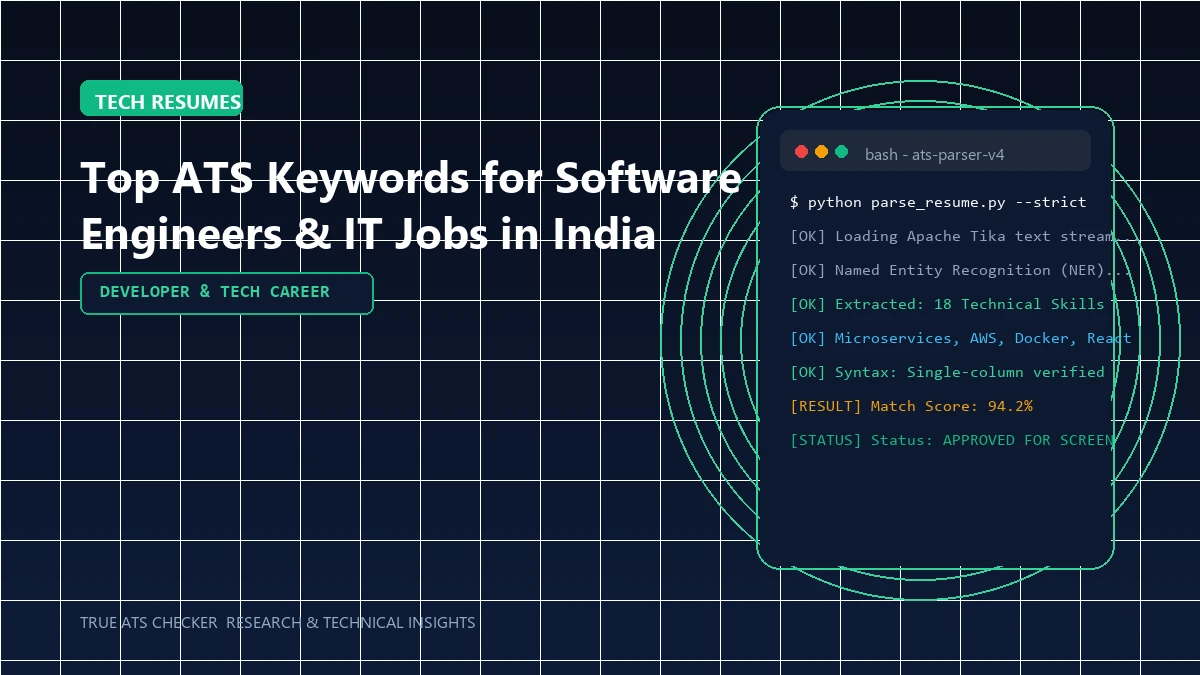
Navigating the Indian hiring landscape requires a dual understanding of global enterprise Applicant Tracking Systems (used by MNCs and GCCs) and domestic platforms like Naukri Resdex. This comprehensive guide details how recruitment screening operates across Indian tech hubs.
Optimizing for ats scanner guide india (updated 2026) requires aligning verified accomplishments with enterprise applicant tracking system parameters and recruiter review habits.
- ✓ Structure credentials in clean, single-column formats to guarantee flawless machine text extraction.
- ✓ Incorporate industry-standard terminology and tool competencies naturally within accomplishment bullets.
- ✓ Quantify commercial and operational results using percentages, dollar values, or project scale metrics.
#Direct Answer: How Indian Recruiters Screen Resumes
- The Notice Period Filter: Indian recruiters place heavy search emphasis on availability. Resumes stating "Immediate Joiner" or "Notice Period: 15–30 Days" receive significantly higher contact rates than those with 90-day locks.
- Keyword Density on Core Stacks: In high-volume tech markets (Bengaluru, Hyderabad, Pune, NCR), recruiters search for exact-match technical combinations (e.g.,
Java AND Spring Boot AND Microservices AND AWS). - Educational Pedigree & GPA Cutoffs: For campus and early-career hiring, filters often require 60%+ or 6.5+ CGPA across 10th, 12th, and college degrees.
The 80% Rule
Most enterprise Applicant Tracking Systems (like Workday and Taleo) require a semantic keyword match score of 80% or higher before forwarding your resume to a human recruiter.
Check your ATS score#How Indian IT Giants and MNCs Screen Resumes
The recruitment landscape in India is characterized by massive applicant volumes. For a single opening at firms like TCS, Infosys, Wipro, Accenture, or multinational Global Capability Centers (GCCs) in Bangalore, Hyderabad, and Pune, talent teams routinely receive 1,000 to 5,000 resumes within 48 hours.
To manage this scale, enterprise Indian employers deploy automated ATS scanners combined with portal filtering criteria:
- Notice Period Filters: Recruiters prioritize candidates with "Immediate", "15 Days", or "30 Days" notice periods. Mentioning your notice period clearly prevents automated exclusion.
- Location & Mobility Tags: Tagging primary tech hubs (e.g., "Bangalore / Hybrid" or "Open to Relocate") ensures inclusion in regional recruiter searches.
- Academic Cutoffs: Many Indian campus drives and MNC hiring programs enforce aggregate criteria (e.g. 60%+ throughout 10th, 12th, and B.Tech). Formatting your degree percentages clearly avoids misread scores.
#Sample Header for Indian Tech Candidates
Rahul Sharma
Bengaluru, Karnataka, India | +91 98765 43210 | rahul.sharma@email.com | linkedin.com/in/rahulsharma
Notice Period: 15 Days (Serving Notice) | Preferred Locations: Bengaluru, Hyderabad, Remote
#Common Mistakes in Indian IT Resumes
- Including Irrelevant Personal Details: Adding marital status, father's name, passport number, or full street addresses wastes valuable resume real estate and adds zero ATS value.
- Listing 50+ Generic Technologies: Listing technologies you barely used dilutes your core domain score. Focus on your primary stack with measurable deliverables.
#Frequently Asked Questions
Which ATS platforms are most common in India?
Workday, Oracle Taleo, Darwinbox, Zoho Recruit, and Naukri RMS (Recruitment Management System) are the dominant platforms across corporate India.
Should I include my CTC (Current / Expected Salary) on my resume?
No. Do not put salary numbers on your resume document. Enter salary details into portal application forms when explicitly requested.
#Conclusion
Optimize your resume for both global MNC parsers and local Indian platforms. Run a free scan on True ATS Checker.
Test Your Resume Against the ATS
Stop guessing. See exactly how applicant tracking systems parse your resume, completely free.
Scan My Resume NowTrue ATS Editorial Team
An expert in career progression and Applicant Tracking System (ATS) optimization. Dedicated to helping job seekers navigate modern hiring algorithms using data-backed insights.