Table of Contents
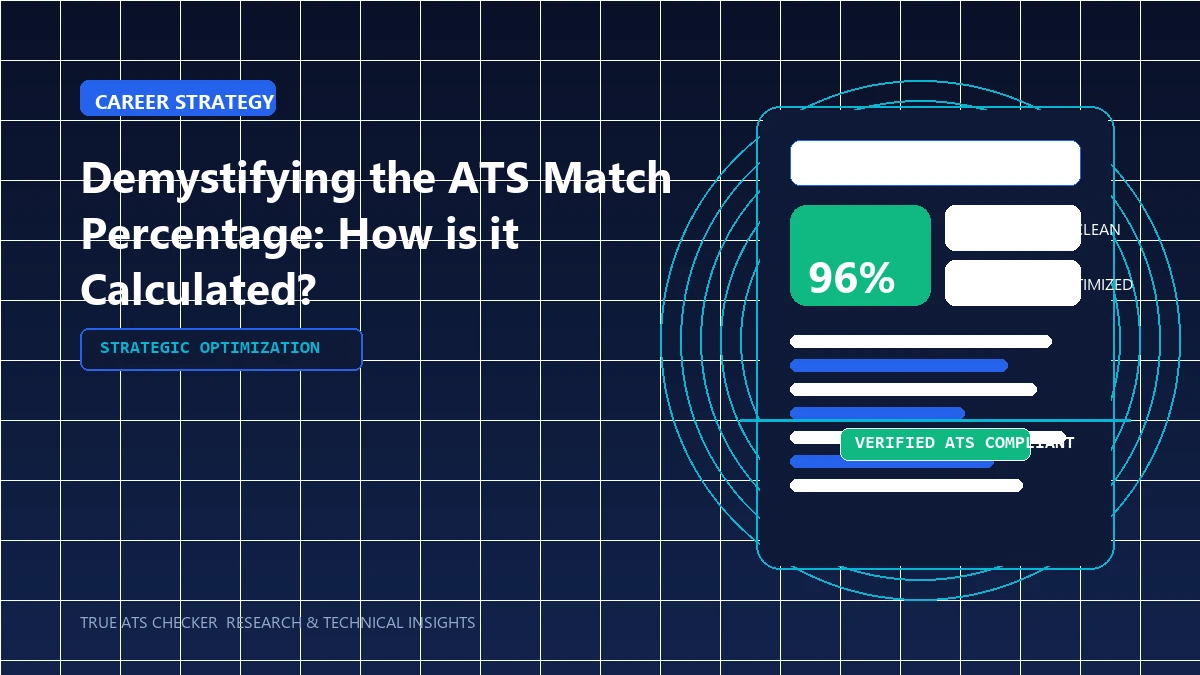
Many online tools display an "ATS Match Percentage" (e.g., "Your resume is an 84% match"). Understanding what this metric actually measures—and what it doesn't—allows job seekers to optimize their applications intelligently.
Optimizing for demystifying the ats match percentage: how is it calculated? requires aligning verified accomplishments with enterprise applicant tracking system parameters and recruiter review habits.
- ✓ Structure credentials in clean, single-column formats to guarantee flawless machine text extraction.
- ✓ Incorporate industry-standard terminology and tool competencies naturally within accomplishment bullets.
- ✓ Quantify commercial and operational results using percentages, dollar values, or project scale metrics.
#Direct Answer: How Match Percentages Are Calculated
A match percentage is an algorithmic comparison between the keywords and qualifications found in your resume versus those specified in the target job posting. It evaluates keyword frequency, semantic similarity, and required credential matches. However, no two enterprise ATS installations calculate scores identically; an employer using Workday might weight minimum years of experience highest, while a startup using Greenhouse might prioritize specific software proficiencies.
The 80% Rule
Most enterprise Applicant Tracking Systems (like Workday and Taleo) require a semantic keyword match score of 80% or higher before forwarding your resume to a human recruiter.
Check your ATS score#The Math Behind ATS Match Scores
How do applicant tracking systems compute the match score (e.g. 84% or 92%) displayed to recruiters? Recruitment algorithms generally apply a weighted token matching formula:
Hard technical skills and required credentials carry the heaviest weight (often 50-60% of the total score). If a candidate possesses the exact required programming languages or professional certifications, their match percentage climbs dramatically.
#Match Score Scenarios: Why 75% Beats 95%
A candidate with a 95% match score might have stuffed generic keywords into their resume, but lack verifiable accomplishments. Conversely, a candidate with an 82% match score who demonstrates high-impact metrics (e.g. "Increased retention by 28% through CRM automation") will consistently win the interview when a recruiter inspects both profiles.
#Misconceptions About Match Percentages
- Believing You Need 100%: A 100% score rarely occurs in genuine applications and often triggers recruiter suspicion of keyword stuffing. Aim for 75% to 88% alignment.
- Obsessing Over Soft Skills: Repeating words like "leadership" or "communication" does little to move the algorithmic score compared to verified hard competencies and domain tools.
#Frequently Asked Questions
Is an ATS score of 70% good enough to get an interview?
Yes. Most recruiters review the top 10-15 candidates in the applicant stack, which typically encompasses candidates scoring between 70% and 85%.
Do ATS checkers provide the exact same score as employer systems?
Each ATS vendor (Workday, Taleo, Greenhouse) configures scoring weights differently. True ATS Checker simulates industry-standard lexical and semantic algorithms to give you an accurate benchmark.
#Conclusion
Aim for an 80%+ match rate to ensure high visibility without awkward keyword stuffing. Test your score on True ATS Checker.
Test Your Resume Against the ATS
Stop guessing. See exactly how applicant tracking systems parse your resume, completely free.
Scan My Resume NowTrue ATS Editorial Team
An expert in career progression and Applicant Tracking System (ATS) optimization. Dedicated to helping job seekers navigate modern hiring algorithms using data-backed insights.