Table of Contents
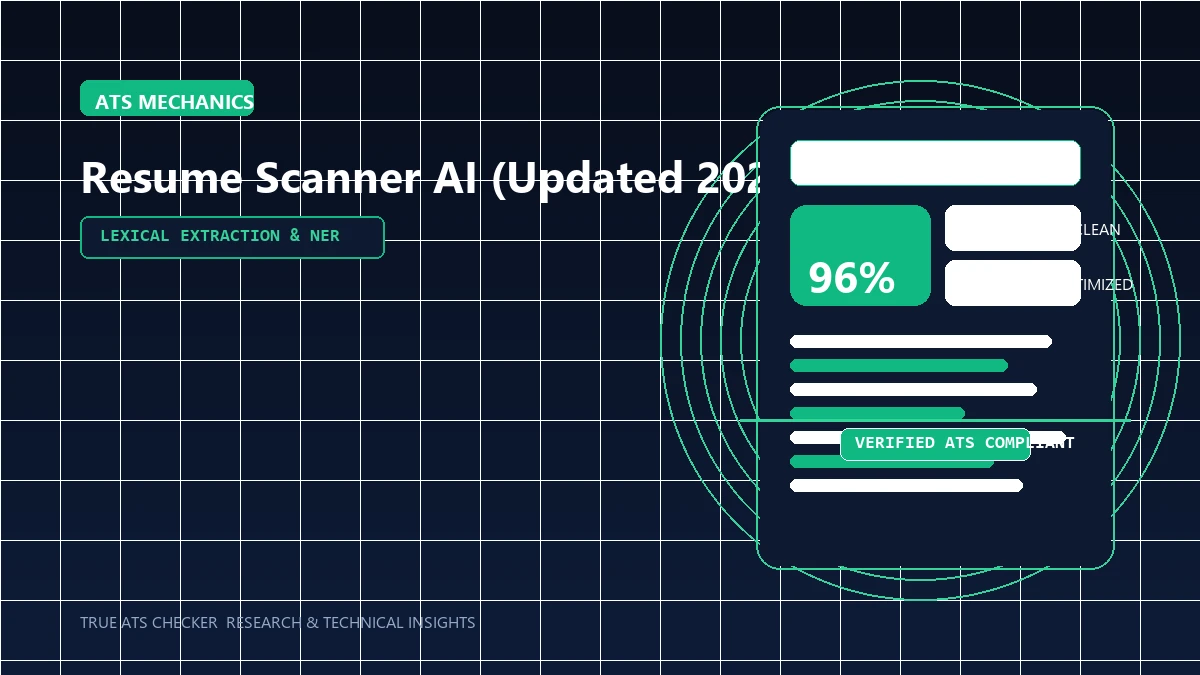
Artificial intelligence is redefining enterprise talent acquisition. Modern recruitment platforms—including Eightfold.ai, Phenom People, and modern Workday modules—use predictive AI to match candidates based on career potential and contextual skill relationships rather than rigid keyword counting.
Optimizing for resume scanner ai (updated 2026) requires aligning verified accomplishments with enterprise applicant tracking system parameters and recruiter review habits.
- ✓ Structure credentials in clean, single-column formats to guarantee flawless machine text extraction.
- ✓ Incorporate industry-standard terminology and tool competencies naturally within accomplishment bullets.
- ✓ Quantify commercial and operational results using percentages, dollar values, or project scale metrics.
#Direct Answer: How AI Resume Scanners Evaluate Candidates
- Ontology & Synonym Mapping: AI engines recognize that a candidate with "Kubernetes" and "Terraform" experience possesses "Cloud Infrastructure" capabilities, even if the latter phrase is absent.
- Trajectory & Tenure Analysis: AI evaluates promotion velocity, tenure stability, and progressive responsibility over time.
- Relevancy Scoring: Candidates are ranked by predicted role success based on historical hiring patterns.
The 80% Rule
Most enterprise Applicant Tracking Systems (like Workday and Taleo) require a semantic keyword match score of 80% or higher before forwarding your resume to a human recruiter.
Check your ATS score#The Evolution from Keyword Matchers to Semantic AI Scanners
Early ATS software operated like basic search engines: if an employer searched for "Python", it counted how many times the word appeared. Modern resume scanner AI (powered by large language models and transformer embeddings) operates on semantic context:
- Contextual Skill Validation: The AI evaluates whether a skill is merely mentioned or actively proven through accomplishments (e.g. "Optimized PostgreSQL queries, reducing latency by 45%" vs just writing "PostgreSQL").
- Semantic Equivalency: Modern AI recognizes that "Revenue Growth", "Commercial Expansion", and "Top-Line Pipeline Development" refer to equivalent executive competencies.
- Career Trajectory Analysis: Algorithms assess progression in job titles and expanding scope of responsibility over time.
#How Semantic AI Evaluates Resume Bullets
"Responsible for team leadership, project coordination, and customer success."
"Led a cross-functional squad of 8 engineers and UX designers to deliver enterprise SaaS features, driving a 34% increase in net customer retention."
#Pitfalls When Writing for AI Scanners
- Generating AI Slop: Submitting raw, unedited ChatGPT outputs filled with empty adjectives ("dynamic visionary who synergizes deliverables") hurts credibility with human hiring managers.
- Ignoring Heuristic Parsing: Advanced AI cannot evaluate your accomplishments if basic document parsing fails to extract your job history cleanly.
#Frequently Asked Questions
Can AI detect if a resume was written by AI?
While AI text detectors exist, recruiters rarely use them to disqualify candidates. Instead, they evaluate whether the content contains specific metrics, authentic projects, and verified experience.
How does True ATS Checker evaluate resumes?
True ATS Checker combines deterministic structural parsing checks with advanced AI semantic analysis to provide instant, actionable scoring without subscriptions.
#Conclusion
Focus on authentic career progression and contextual accomplishments. Audit your AI readiness with True ATS Checker.
Test Your Resume Against the ATS
Stop guessing. See exactly how applicant tracking systems parse your resume, completely free.
Scan My Resume NowTrue ATS Editorial Team
An expert in career progression and Applicant Tracking System (ATS) optimization. Dedicated to helping job seekers navigate modern hiring algorithms using data-backed insights.